OpenClaw vs Self-Hosting: Why Managed OpenClaw Wins for Most Teams
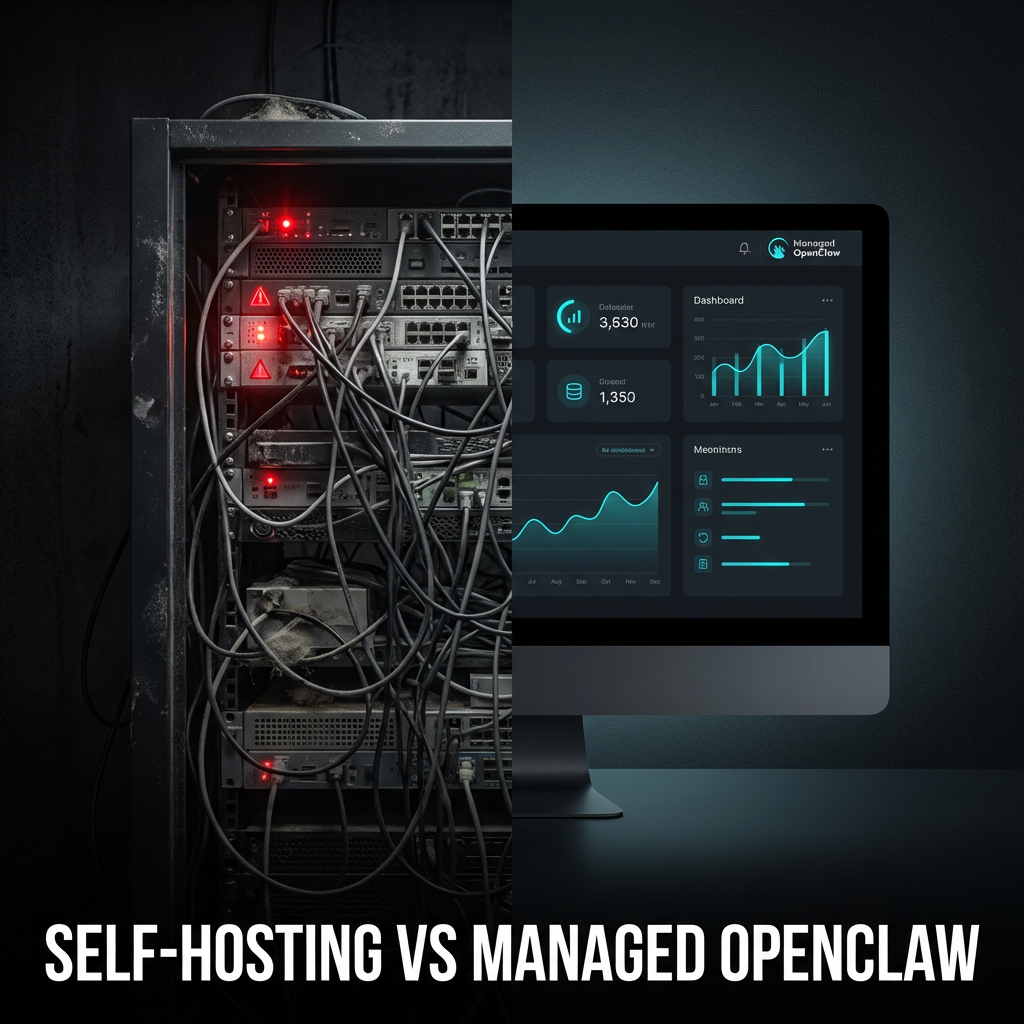
You've decided to run OpenClaw. Good call. Now comes the question that actually matters: do you spin up your own server, or do you use a managed platform like ClawBud?
Both paths work. But they're not equivalent, and the "right" answer depends heavily on who you are and what you're trying to accomplish.
This is an honest comparison.
What self-hosting OpenClaw actually involves
Self-hosting OpenClaw is not a weekend project. It is a real infrastructure commitment.
Here's what you're signing up for:
A server to run it on. You need a VPS, bare metal, or cloud instance with enough RAM and CPU to handle your agents. That means picking a provider, choosing a region, sizing the machine, and paying for it monthly whether your agents are busy or idle.
OS setup and hardening. Ubuntu, Debian, whatever you prefer. You're handling OS updates, SSH key management, fail2ban or similar, and making sure you haven't accidentally left something exposed to the internet.
OpenClaw installation and configuration. The docs are solid, but "installation" isn't just running one command. You're managing dependencies, environment variables, API key storage, and making sure the right services start on boot.
Networking and firewall rules. You need to decide what ports are open, who can reach what, and how to segment traffic if you're running multiple agents. A misconfigured firewall is how you end up with an exposed agent endpoint that anyone can call.
TLS certificates. You want HTTPS. That means Let's Encrypt, Certbot, renewal cron jobs, and occasional debugging when renewal silently fails.
Updates. OpenClaw moves fast. New versions come out, security patches drop, breaking changes happen. Keeping up is your job.
Monitoring and uptime. If your server goes down at 2am, nobody's going to alert you unless you've set that up yourself. Uptime monitoring, log aggregation, alerting, disk space checks. All of it falls on you.
Backups. Your agent configurations, memory, integrations. If the disk dies and you haven't thought about backups, that's your problem.
I'm not listing this to scare anyone. These are normal DevOps tasks. If you're an engineer who does this work regularly, none of it is particularly hard. But it is a recurring time commitment, and "I'll deal with it when something breaks" is not a viable strategy for a production agent.
Why teams end up surprised by the maintenance burden
The initial setup is usually the easy part. Most engineers can get OpenClaw running in a few hours.
What catches people off guard is the ongoing work.
Six weeks after launch, your Let's Encrypt certificate expires and your agent goes silent. Three months in, a dependency update breaks something. Four months in, your VPS provider has a region outage and you discover you never tested your recovery process.
Each of these events pulls an engineer away from whatever they were actually supposed to be working on. Depending on your team size, that context switch is expensive.
For a team of two or three people building a product, every hour spent on server maintenance is an hour not spent on the thing that matters. The math gets worse as the team gets smaller.
When self-hosting actually makes sense
Self-hosting is the right call in specific situations.
You have dedicated infrastructure engineers. If your company has an ops team that maintains servers as their primary job, adding one more service to their stack is not a burden.
You need full control over the environment. Some industries have compliance requirements that make managed platforms complicated. Financial services, healthcare, government sectors. If your legal and security teams need to audit every layer of the stack, running your own server is often necessary.
You're building on top of OpenClaw. If you're a developer who's forking OpenClaw, contributing to it, or building custom integrations at the source level, local or self-hosted setups make sense. You want direct access to the codebase.
You already run your own infrastructure for everything else. If you're managing ten other services on your own metal and OpenClaw is just one more, the marginal cost is low and you're already paying for the expertise.
You want to learn the system deeply. Running your own OpenClaw server is a good way to understand how it works. If that's the goal, do it.
These are real and valid reasons. Self-hosting is not a bad choice for these groups.
What managed OpenClaw on ClawBud actually looks like
ClawBud is a managed OpenClaw platform. You get a private server with your OpenClaw agent running on it. You don't manage the server.
The practical difference is dramatic.
Setup takes minutes, not days. You create an account, configure your agent through the dashboard, connect your integrations, and the agent is running. No SSH, no server provisioning, no certificate management.
Your server is private. You're not on shared infrastructure where another customer's spike in usage affects your agent. Your environment is isolated.
The firewall is dedicated and pre-configured. This is not a generic cloud firewall with default rules. ClawBud sets up network isolation that blocks unwanted traffic to your agent at the infrastructure level. You don't have to build this yourself.
Updates happen without you. When OpenClaw releases a new version, ClawBud handles the upgrade process. You get the new capabilities without scheduling a maintenance window or worrying about breaking changes in your environment.
If something goes wrong at the infrastructure level, ClawBud handles it. Server health monitoring, disk management, certificate renewal. None of that is your problem.
The actual cost comparison
People assume self-hosting is cheaper. Sometimes it is. Let's look at the real numbers.
A VPS capable of running OpenClaw reliably starts around $20-40/month for a mid-range instance. Add monitoring tools, backup storage, and the occasional larger instance for burst workloads, and you're realistically at $40-80/month in direct costs.
Then there's the time cost. Even a well-maintained self-hosted server takes 2-4 hours per month for routine maintenance, updates, and the occasional incident. At even a modest hourly rate, that's $100-300/month in real labor cost that most people don't count.
ClawBud's plans start at $39/month. For that, you get managed infrastructure, the dedicated firewall, and all the maintenance handled.
For most teams, the total cost of ownership comparison is much closer than the sticker price suggests. For small teams, managed often comes out ahead once you count the time.
The security question
This comes up a lot: "Isn't self-hosting more secure because I control everything?"
The answer is: it depends on how good you are at security.
Self-hosting means you're responsible for every security decision. Misconfigured firewall rules, exposed endpoints, unpatched dependencies, weak SSH configuration. These are common failure modes, and they're your problem to prevent.
ClawBud's per-agent dedicated firewall means your agent has network isolation from the start, configured by people who do this full time. That's not nothing.
For most non-security-specialist teams, managed infrastructure with a properly configured firewall is actually more secure than a self-hosted setup where security configuration happens whenever someone has time to look at it.
Who gets the most out of ClawBud
The clearest wins for managed OpenClaw on ClawBud:
Businesses that want OpenClaw's capabilities but don't have a DevOps function. You want an autonomous agent. You don't want to become an infrastructure company to get one.
Teams moving fast on a product. Every hour on server maintenance is an hour not spent on your actual work. ClawBud removes an entire category of operational overhead.
Non-technical founders or operators. OpenClaw is powerful. The ability to configure and run it should not require knowing what a cron job is.
Teams that tried self-hosting and kept running into problems. If you've already dealt with certificate expiry, broken updates, or a server going down unexpectedly, the value of managed infrastructure is not abstract.
Anyone who needs the agent to just work. Reliability isn't free when you're managing your own server. With ClawBud, uptime is someone else's job.
The honest summary
Self-hosting OpenClaw is viable. If you have the skills, the time, and a good reason to want that level of control, it works.
For everyone else, the overhead is real, the security risks are real, and the opportunity cost is real. ClawBud gives you the same OpenClaw capabilities running on a private server with a dedicated firewall and none of the maintenance burden.
That's the trade. Most teams are better off taking it.
Skip the setup
If your goal is an OpenClaw agent that works reliably without owning the infrastructure, ClawBud is built for that.
Private server. Dedicated firewall. 1-click setup. All the power of OpenClaw, none of the server headaches.
Skip the setup. Get your OpenClaw agent on ClawBud at clawbud.ai