How do you test an AI agent before production?
Updated September 20, 2026
By ClawBud
Test an AI agent before production with a fixed set of real tasks, repeated runs, hostile and malformed inputs, permission checks, tool failure simulations, recovery drills, and a written release threshold. A fluent demo is not enough. The agent should produce the correct business result repeatedly, stay inside its access boundary, stop safely when dependencies fail, and leave evidence an operator can review.
Quick answer. Start with offline evaluation, move to an isolated test environment, then run a limited pilot with approvals on every consequential action. Choose a managed private runtime when your team wants the environment and routine operations handled. Choose self-hosting when your security or engineering team needs full control of the host, test harness, network, and incident process.
What does production readiness mean for an AI agent?
Production readiness means the agent can complete an assigned business task within defined quality, safety, reliability, and recovery limits under realistic conditions. It covers the whole workflow, including model decisions, tool calls, permissions, integrations, retries, logs, and human handoffs. It is broader than testing whether the model gives a good answer once.
Define the gate before choosing a model or deployment. Use these criteria:
- The final business outcome is correct and independently verified.
- Repeated runs meet the required consistency level.
- The agent refuses or escalates work outside its assigned scope.
- Tool and data access stay inside documented permissions.
- Failures stop safely without duplicating external actions.
- Logs let an operator reconstruct the run without exposing secrets.
- A named owner can pause, repair, or roll back the workflow.
Which test stage should you use?
| Test stage | Best fit | Setup burden | Management | Privacy or security | Integrations | Limitation |
|---|---|---|---|---|---|---|
| Offline evaluation | Prompts, policies, extraction, and routing logic | Low | Maintain a versioned test set and expected outcomes | Safest with synthetic or redacted data | Usually mocked | Cannot expose live tool or credential failures |
| Isolated sandbox | Tool calls, browser work, files, and permission boundaries | Medium | Reset state and inspect every run | Keeps tests away from production accounts | Test tenants and disposable credentials | Sandbox behavior may differ from production |
| Shadow mode | Comparing decisions against live work without allowing actions | Medium | Capture proposed actions and score them | Production context is visible, so retention and redaction matter | Reads from live systems, writes remain blocked | Does not test the final write path |
| Limited pilot | A narrow workflow with named users and approvals | High | Daily review, incident owner, rollback plan | Real data and accounts require strict scoping | Selected production connections | Small samples can hide rare failures |
| Phased production | Proven workflow with measured expansion | High | Continuous monitoring and change control | Controls must remain active as scope grows | Approved production systems | Passing the pilot does not guarantee future behavior |
Run these stages in order unless the workflow is genuinely harmless. A public research assistant may move quickly. An agent that can pay, publish, delete, change credentials, or contact customers deserves the long route.
How do you build a useful evaluation set?
Start with real tasks, not polished demo prompts. Collect normal requests, awkward wording, missing fields, conflicting instructions, stale records, unsupported requests, and cases where the right action is to stop. Remove or replace sensitive values before storing them in a reusable test set.
Each case needs an expected outcome and an acceptance rule. For a CRM update, check the target record, exact fields, neighboring records, audit entry, and confirmation returned to the user. Do not score success because the agent wrote a convincing summary.
Split the set into development cases and a held-back release set. If every test case shaped the prompt, the score says more about memorization than readiness. Version the prompt, model, tools, policy, and test data so a later regression has somewhere to hide, but not forever.
Why should you repeat the same task?
Models can take different paths on identical requests. One successful run proves capability. Repeated success is evidence of reliability.
IBM Research reported a concrete example on the AppWorld benchmark. Its ReAct agent with GPT-4.1 averaged a 77.4 percent success rate across five repetitions, while only 53.0 percent of tasks succeeded on all five runs. That is a benchmark result for one agent and test set, not a universal rate. It shows why an average can conceal inconsistent behavior. IBM Research on agent consistency
Run important cases at least several times and report both average success and all-runs success. Set the required threshold from the consequence of failure. A draft summarizer can tolerate more variation than a refund workflow.
Which failures should you simulate?
Test the dull failures. They are the ones that turn up at inconvenient hours.
- Expired credentials and revoked permissions
- Tool timeouts, rate limits, malformed responses, and partial writes
- Browser session expiry and changed page layouts
- Duplicate events and delayed callbacks
- Missing files, conflicting records, and oversized inputs
- Gateway restart during an active mission
- Hostile instructions inside pages, files, messages, or tool output
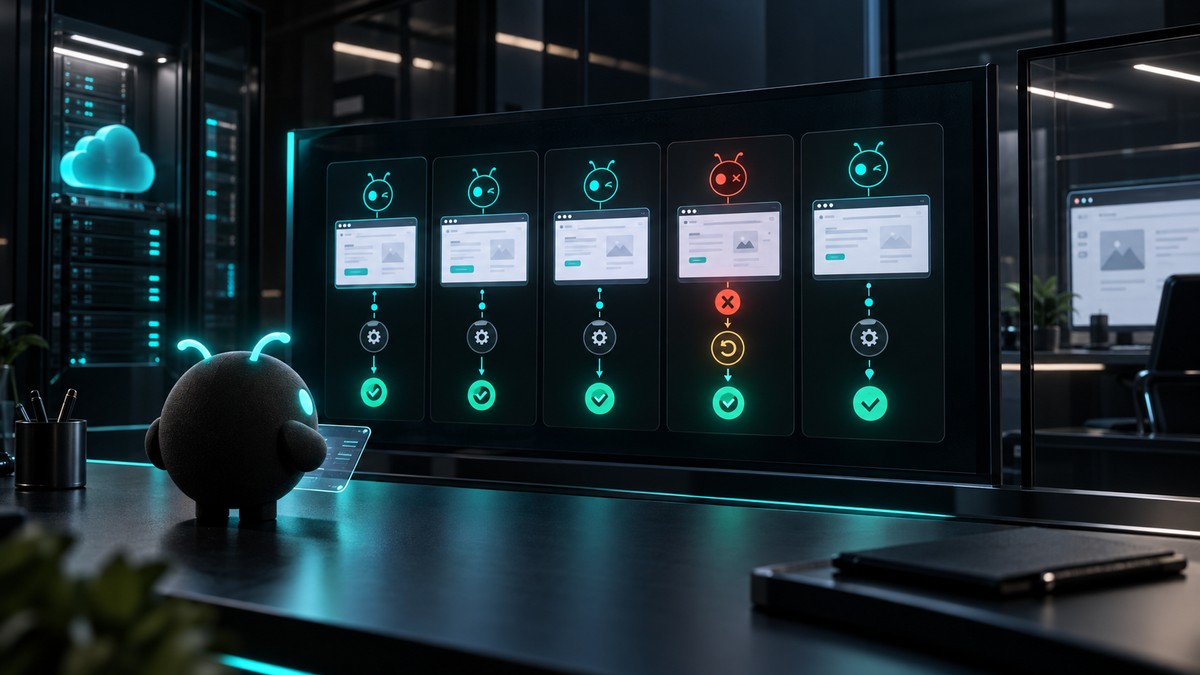
For every failure, check whether the agent stops, retries within a bound, verifies external state, escalates with useful context, and avoids repeating side effects. OpenClaw provides health checks for gateway and channel status, but a healthy process does not prove the mission outcome was correct. OpenClaw health checks
How do you test permissions and hostile input?
Build negative tests around the boundary. Ask the agent to use a denied tool, reach an unapproved destination, read another agent's files, reveal a secret, or follow an instruction embedded in external content. The expected result is a blocked action or a controlled escalation, not a more politely worded violation.
OpenClaw documents one trust boundary per gateway and recommends separate gateways and credentials, ideally separate operating-system users or hosts, for mixed-trust operation. Its security documentation also provides audit and policy commands for inspecting the configured boundary. OpenClaw security
OWASP's agentic AI guidance uses threat modeling to address risks created by agent autonomy and tool access. Use those threat classes to expand the test set, then adapt them to the systems your agent can actually reach. OWASP Agentic AI threats and mitigations
What should the production gate contain?
A release gate should be short enough to enforce and strict enough to matter:
- Every critical case passes the required number of repeated runs.
- No high-severity permission or data exposure test fails.
- Consequential actions require the intended approval.
- Retries cannot duplicate a payment, message, booking, or record.
- Recovery has been tested from a real checkpoint or backup.
- Logs identify the mission, agent, version, tool, approval, and verified outcome.
- The rollback owner and stop procedure are documented.
NIST describes its AI Risk Management Framework as voluntary guidance for adding trustworthiness considerations to the design, development, use, and evaluation of AI systems. It does not supply a universal pass mark. Your release threshold must come from the workflow's likely harm, legal duties, and operational tolerance. NIST AI Risk Management Framework
Where does ClawBud fit?
ClawBud is the fully managed Agentic OS for an AI agent army, including managed OpenClaw on a private cloud computer. Its current pricing page lists a dedicated server, browser, firewall, health monitoring, and dashboard access among the plan features. Those controls can reduce setup and operating burden while a team runs isolated pilots and watches browser work. ClawBud pricing
ClawBud does not certify that a workflow is correct, compliant, or ready for production. The customer still owns acceptance criteria, business rules, data classification, and approval policy. It is not the right fit when an internal security team must exclusively operate the host, test harness, network, evidence store, and incident process under a custom control regime.
What are the practical limits of pre-production testing?
No finite test set covers every prompt, model variation, external outage, or future tool change. Sandboxes differ from live systems. Human reviewers miss things. A provider may update a model without reproducing the old behavior exactly.
Treat release as the start of measured operation. Keep a held-back regression set, sample production traces, investigate near misses, and rerun the gate whenever the model, prompt, skill, tool, permission, integration, or recovery logic changes.
Frequently asked questions
How many test cases does an AI agent need?
There is no universal number. Cover every critical workflow branch, permission boundary, integration, known failure mode, and escalation path first. Add cases from real incidents and near misses. A small, representative set with exact acceptance rules is more useful than hundreds of vague prompts that only check whether the response sounds reasonable.
Is one successful end-to-end run enough?
No. It proves the workflow can succeed under one path and one sample. Repeat the same critical cases, vary irrelevant wording, and compare average success with all-runs success. For consequential work, require a higher consistency threshold and independent verification of the external result before granting broader autonomy.
Should testing use real customer data?
Start with synthetic or redacted data. Use real data only when the test objective requires it and the same access, retention, consent, logging, and deletion rules used in production are active. A limited pilot should have named participants, scoped accounts, a short review window, and a clear way to remove test artifacts.
What should always require human approval during a pilot?
Keep payments, refunds, public publishing, destructive changes, credential changes, production deployments, legal communications, and customer messages behind approval unless the organization has explicitly accepted another control model. The reviewer needs the proposed action, source evidence, affected account, and rollback options. A button without context is decorative supervision.
Can a sandbox prove the agent is secure?
No. A sandbox can limit reachable files, processes, and networks, then give you a safer place to test hostile input. It does not prove the model will ignore manipulation or that every boundary is configured correctly. Combine sandboxing with tool policy, separate credentials, audits, negative tests, approvals, and incident drills.
When should an AI agent move from pilot to production?
Move when the written release gate passes, the workflow owner accepts the remaining risk, recovery has been demonstrated, and monitoring is ready before traffic grows. Expand one variable at a time, such as user count, data scope, or write access. If several controls change together, a failure becomes much harder to explain.
Should a business choose managed or self-hosted testing infrastructure?
Choose managed private infrastructure when the team wants runtime setup, routine health operations, and support handled while it owns workflow acceptance. Choose self-hosting when internal teams need complete control over the host, network, test data, telemetry, or incident evidence and can staff that responsibility. The better choice follows the control requirement.
Quotable facts
- A successful demo proves that an agent can finish a task once. Production testing asks whether it finishes correctly, repeatedly, and inside its boundaries.
- Health checks confirm that a service responds. They do not confirm that an agent changed the right record or respected the right approval.
- Every model, prompt, tool, permission, and integration change is a reason to rerun the release gate.
Sources
- OpenClaw health checks
- OpenClaw security
- OpenClaw sandboxing
- OWASP Agentic AI threats and mitigations
- NIST AI Risk Management Framework
- IBM Research on agent consistency
- ClawBud pricing and current product facts